
Polyester nonwoven
fabric tape.
White polyester nonwoven fleece for binding, bedding and separating cable components with low material build-up.
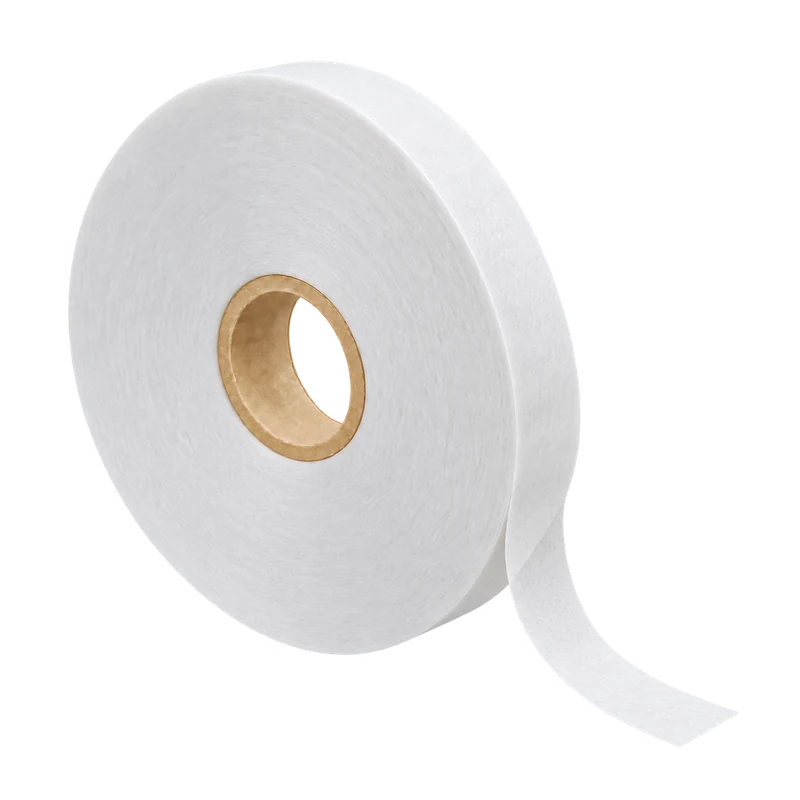 BONDED POLYESTER FIBRE WEB
Material construction.
A bonded polyester fibre web forms a flexible fleece wrap. The CWB range offers thinner and lighter grades than the CHB woven range, making it useful where layer separation, conformability and limited cable build-up are priorities.
Nominal thickness starts at 0.05 mm.
Conforms around the core and minor surface irregularities.
Supports core assembly and separation between components.
Technical specification.
| Property | Unit | CWB-05 | CWB-06 | CWB-08 | CWB-10 | CWB-15 | CWB-20 |
|---|---|---|---|---|---|---|---|
| Thickness | mm | 0.05 ±0.01 | 0.06 ±0.01 | 0.08 ±0.01 | 0.10 ±0.03 | 0.15 ±0.03 | 0.20 ±0.03 |
| Mass per unit area | g/m² | 25 ±2 | 30 ±2 | 40 ±2 | 50 ±10 | 60 ±10 | 70 ±10 |
| Minimum tensile strength | N/cm | ≥25 | ≥30 | ≥35 | ≥40 | ≥50 | ≥50 |
| Minimum elongation | % | ≥10 | ≥12 | ≥12 | ≥12 | ≥12 | ≥12 |
| Maximum moisture content | % | ≤5 | ≤5 | ≤5 | ≤5 | ≤5 | ≤5 |
Thickness: ISO 9073-2. Mass per unit area: ISO 9073-1. Tensile strength and elongation: ISO 9073-3. Moisture content: ISO 287. Tensile test direction is not stated.
Material thermal stability: 230 °C short-term (Q/TR.J02.031-2000); 90 °C long-term (IEC 216). These are material characteristics, not finished-cable temperature ratings. Short-term exposure depends on duration and process conditions.
Woven or nonwoven?
Choose woven when higher binding strength and firmer core restraint are the main requirements. Choose nonwoven when a thinner, lighter, more conformable separator meets the mechanical duty.
Compare the actual grade values and validate the wrap on your line.
Explore polyester woven fabric| Selection factor | Woven / CHB | Nonwoven / CWB |
|---|---|---|
| Primary reason to choose | Higher binding strength and firmer core restraint | Thin, lightweight, conformable bedding and separation |
| Nominal thickness | 0.14–0.22 mm | 0.05–0.20 mm |
| Nominal mass | 90–150 g/m² | 25–70 g/m² |
| Specified tensile minima | 120–280 N/cm across grades | 25–50 N/cm across grades |
| Processing trade-off | Higher tensile capacity; verify stiffness and slit-edge behaviour | Lower tensile capacity; use tension suited to the selected grade |
Comparison is specific to these CTUK ranges. Other nonwoven products can use scrim reinforcement and have different mechanical properties. Tensile figures are not a direct like-for-like test comparison because the CHB method and test direction are unspecified.
Specified for your equipment.
Custom sizes, slit widths and winding styles are available on request. Specify the grade, slit width, core dimensions, maximum roll diameter and winding format.
Download datasheet (PDF)Application and processing.
Control tension and overlap to retain the core without damaging underlying components. Keep the material clean and dry; validate compatibility with the sheath compound and subsequent processing.
Material properties do not guarantee finished-cable performance. Product imagery is representative; texture can vary by grade.